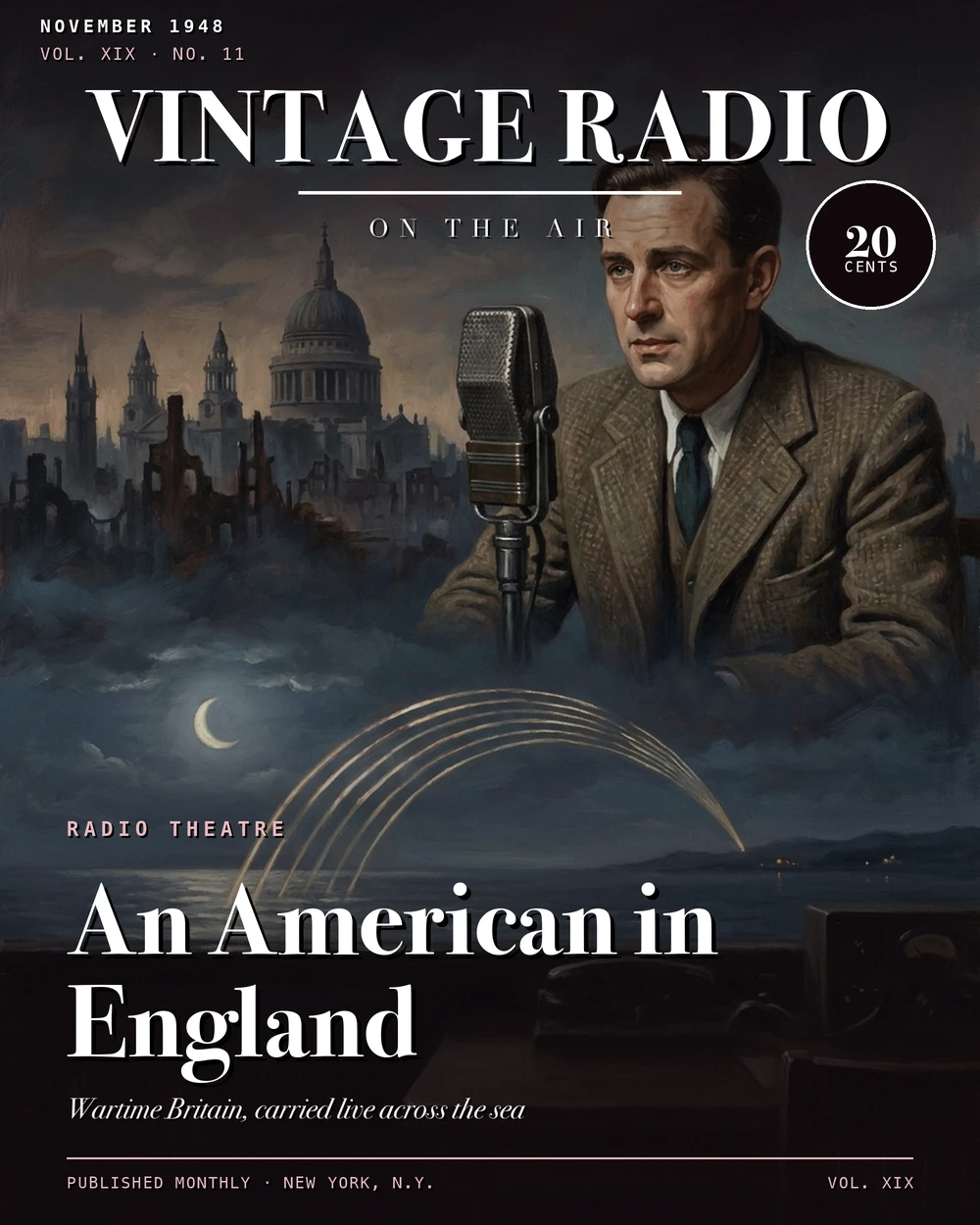
An American in England
The Idea Behind the Series
When CBS sent Norman Corwin to Britain in the summer of 1942, they weren't asking him to file dispatches or interview cabinet ministers. They wanted something harder to define: the character of a nation under siege, captured from the inside. Corwin himself was clear about what the mission was not. The main objective, he said, was "to establish the character of the British people, not to disseminate handouts from the Ministry of Information." In four months in England, he never once interviewed a high government official. What he gathered instead were soldiers, sailors, miners, workers, a theater manager, an elevator man, a police officer named Gilbert, and families like the Everingtons and the Westerbys — the texture of ordinary British life in wartime, turned into radio drama.
The series was conceived as a joint CBS-BBC co-production, with the BBC providing production infrastructure in Britain for what would become live shortwave broadcasts to CBS headquarters in New York. It was also explicitly aimed at countering anti-British propaganda circulated by the America First Committee and educating American audiences about wartime Britain. Erik Barnouw, writing later in Radio Drama in Action, described the series as suggesting "a fusing of the drama of Corwin and the journalism of Murrow" — "closely related forms of expression," as he put it. That's as good a two-line description of the show as exists.
Corwin's co-producer was Edward R. Murrow, already established in London as America's most trusted voice from Europe. Murrow's involvement wasn't ceremonial — he shared an office with Corwin in wartime London, made introductions, and shaped the direction of individual broadcasts, including suggesting the small coastal town of Cromer as a subject. Alexander Kendrick's biography Prime Time: The Life of Edward R. Murrow treats Murrow's role in the series as integral enough to figure in the journalist's biographical record.
Time magazine, writing in December 1942, described Corwin's mission as trying "something that U.S. radio had not done before" — explaining England to Americans by short-waving his dramatized observations of the English. That framing captures the novelty of it: not straight news, not pure drama, but something in between, built from direct observation and shaped for the ear.
A Troubled Start
The first show was scheduled for July 27, 1942. It did not go as planned. Corwin had written a pretitle scene in which actor Joseph Julian — playing the "American in England" through whom the series' perspective flowed — was struggling to make a telephone connection. An engineer in the relay chain, hearing Julian say "Hello? . . . Hello? . . . What's the matter with this line?" assumed the shortwave signal had failed and pulled the broadcast off the air, replacing it with alternate programming. Corwin recalled afterward that no one had heard that first show, "except maybe a lonely RAF pilot flying over London." Murrow was the one who broke the news.
The technical challenges weren't limited to that incident. Before the broadcasts began, Corwin had tested the shortwave signal with CBS executive Davidson Taylor using a closed-circuit London-to-New York procedure. What the test revealed was stark: a door slamming in the studio came across on the transatlantic signal "like a bomb going off." Corwin wrote that the sound effects test immediately ruled out at least two-thirds of his intended repertoire of sound. Working live at 4 a.m. London time, carrying the signal across the ocean and back to American affiliate stations, the technical margin for error was essentially zero.
After the failed first attempt, Corwin and Murrow decided to redo the same show the following week — what became the effective American premiere on August 3, 1942. The show that was cut off, titled "London by Clipper," was long considered lost. It was found on October 23, 2014 by a researcher at the Library of Congress in Washington, D.C. (call number LWO 5833 GR31 21B2–3), after decades of failed searches on both sides of the Atlantic. The discovery turned out to carry an additional significance: the recording represents one of the earliest documented performances of horn player Dennis Brain, then 20 years old and serving in the Royal Air Force Symphony Orchestra that performed Britten's score.
The Two Runs
The first run of An American in England went from August 3 through September 7, 1942 on CBS, airing Mondays at 10 p.m. Six episodes were broadcast live from Britain via shortwave. The September 7 broadcast was cut short by atmospheric interference, and by then the stormy season had arrived in force. Corwin returned home and produced four additional episodes from CBS New York, airing Tuesdays at 10 p.m. from December 1 through December 22, 1942.
The four New York-produced episodes had their own titles: "Cromer" on December 1, "Notes at Random" on December 8, "An Anglo-American Angle" on December 15, and "Clipper Home" on December 22. "An Anglo-American Angle" was a revised version of an earlier first-run script — Corwin explained it would be "generally revised and synthesized in the light of observations made since the original broadcast." The final episode, "Clipper Home," expressed humanitarian sentiments that one critic, writing in Embarrassing Treasures in 2012, noted extended to people of all nations, though the same critic described the series more broadly as "wordy and rather unsubtle in its propaganda." The "Cromer" episode — about a small coastal town just 30 minutes' flying distance from Germany, where the stained glass windows of the Church of St. Peter and St. Paul had been blown out by a bomb and an organist's practice carried across to the post office opposite — was later reworked and rebroadcast as part of Columbia Presents Corwin on May 9, 1944. It was also included in Norman Corwin's Centennial Collection, released by Radio Spirits in 2010.
Joseph Julian and the Voice of the American
Corwin needed a radio actor to carry the perspective of the American narrator, even though that American was Corwin himself. He auditioned British actors and found none that suited the role. A call to New York produced Joseph Julian, born Joseph Shapiro in St. Marys, Pennsylvania in 1911 — a veteran of more than 10,000 radio broadcasts over his career, with experience on NBC and CBS going back to his early work on Forecast and The Columbia Workshop. It was Julian's prior work on This Is War that had brought him to Corwin's attention in the first place.
Julian was dispatched to England on a bomber, arriving the day before the scheduled broadcast — the one that failed. Despite that chaotic beginning, his performance in the weeks that followed was noticed. When Julian returned to the United States, he found that the press had lauded his work during the run. He became one of Corwin's most trusted and frequently used players, including recurring roles on Columbia Presents Corwin.
Julian later published a memoir of his radio career, This Was Radio (Viking Press, 1975), which covers his experiences on the series. His career was interrupted in the early 1950s when he was named in a blacklist pamphlet alongside Norman Corwin, Howard Duff, Dashiell Hammett, Paul McGrath, Orson Welles, and others. Julian fought the allegations and eventually cleared his name. His papers, covering 1942 through 1977, are held at the American Heritage Center at the University of Wyoming.
The Music: Britten, the RAF, and Lyn Murray
For the shortwave broadcasts from Britain, the music was composed by Benjamin Britten and performed by a 60-piece Royal Air Force Symphony Orchestra. Britten had recently returned to England from the United States in the spring of 1942. Within weeks of his return, he registered as a conscientious objector and began writing scores for wartime radio propaganda programs — An American in England being the first of these. NMC Recordings, which released an album of Britten's work in 2013 under the title Britten to America, described the score as written for "six programmes about wartime conditions in England produced by the BBC for live transmission in the USA by CBS" — music that had been largely unheard since the 1940s.
It was during rehearsals for the series that Dennis Brain first met Britten. Brain asked Britten to write him a concerto. Britten instead wrote the Serenade for Tenor, Horn and Strings for Brain and tenor Peter Pears, which debuted on October 15, 1943 at Wigmore Hall in London. Britten used breaks during the RAF orchestra rehearsals to review and refine that score. BBC Music Magazine described the NMC recordings as presenting Britten "at the height of his early, pre-Grimes powers."
For the four New York-produced episodes in December 1942, the music was provided by Lyn Murray, a CBS staff conductor and arranger born Lionel Breeze in London in 1909. Murray had attended the Juilliard School and had been a CBS staff composer since 1934. He was also the founder of the Lyn Murray Singers, the featured choral group on Your Hit Parade. After the war, Murray went on to compose for film and television, including Alfred Hitchcock's To Catch a Thief and 35 episodes of The Alfred Hitchcock Hour. He won an Emmy Award in 1986 for the National Geographic special Miraculous Machines.
What the Series Set in Motion
An American in England was not a one-off. The production model it established led directly to two follow-up series: An American in Russia, which aired on CBS in January 1943 (directed by Guy della Cioppa and narrated by CBS newsman Larry Lesueur), and Transatlantic Call, produced by Corwin for CBS and the BBC later that year. Scripts from the series were reprinted in Erik Barnouw's anthology Radio Drama in Action (Farrar & Rinehart, 1945). Corwin's own account of making the series appears in Untitled and Other Radio Dramas (Henry Holt and Company, 1947). The series is examined in the scholarly work Anatomy of Sound: Norman Corwin and Media Authorship (University of California Press), which treats "London by Clipper" and other episodes as key texts in Corwin's bibliography.
Corwin himself went on to become one of the dominant figures in American radio. Ray Bradbury called him "the greatest director, the greatest writer and the greatest producer in the history of radio." He was described by NPR and his contemporaries as having been, at his peak in the 1940s, nearly as well known as President Franklin Roosevelt. He was inducted into the Radio Hall of Fame in 1993, and a documentary about his life, A Note of Triumph: The Golden Age of Norman Corwin, won the Academy Award for Best Documentary Short Feature in 2006. He lived to 101, dying on October 18, 2011. His papers — correspondence, manuscripts, scripts, and more than 140 recordings — are held at Syracuse University Libraries.
An American in England ran for ten episodes across two separate runs, lasted less than six months, and operated under conditions that would have stopped most productions before they started. What it left behind was a method — part journalism, part drama, built on the voices of ordinary people — and a template for transatlantic radio collaboration that the networks returned to more than once.